
Jordanian stone facades: types, cutting styles and maintenance
The word stone alone is not enough in a contract. Type, finish, cutting pattern, thickness and fixing method make the difference between two facades of the same stone.
Arch Mohannad Al-Sharif · Published · 7 min read
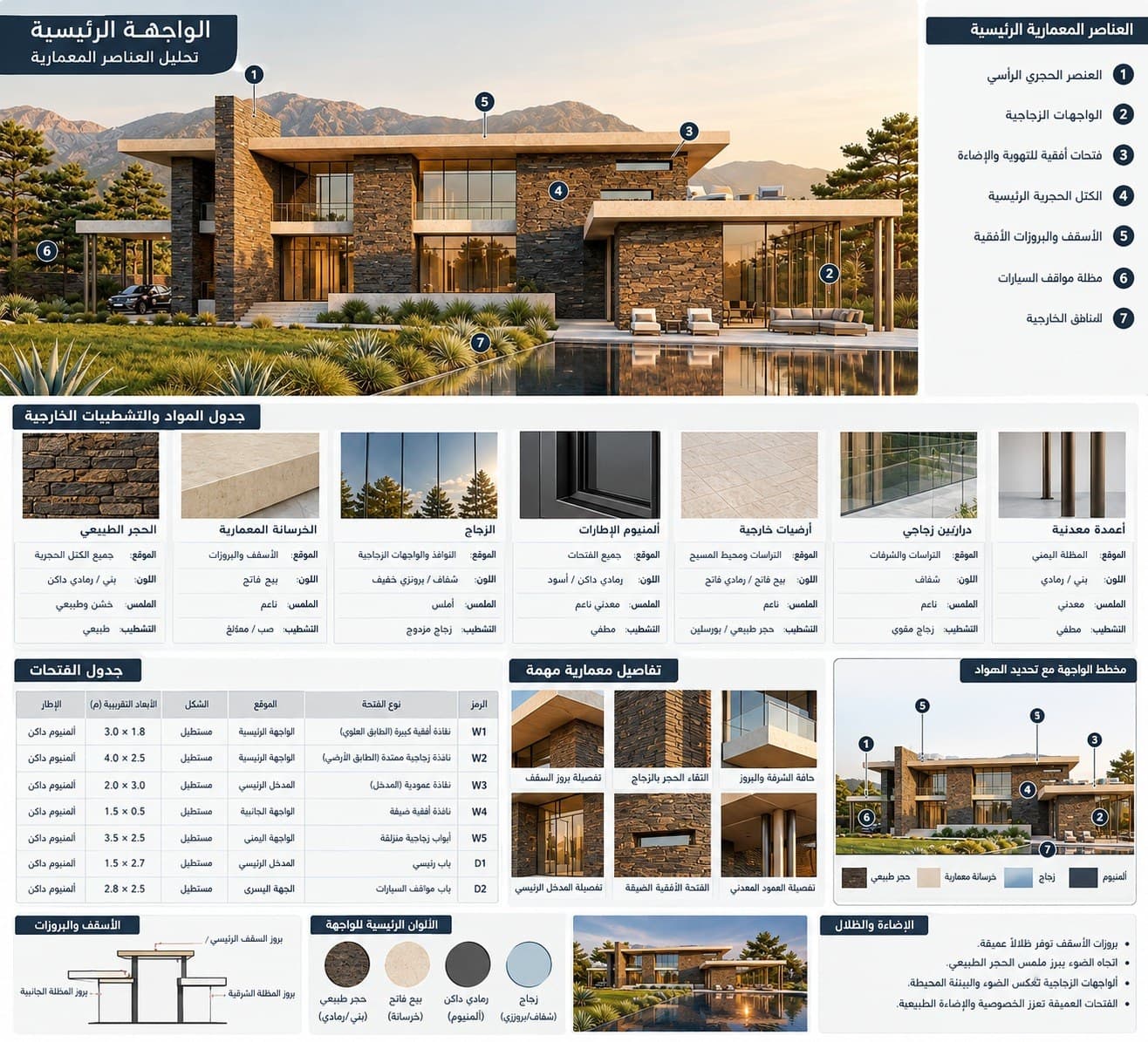
Main facade analysis board: facade elements, exterior materials and finishes schedule, and opening schedule
Jordanian stone facades: why stone is the base material in Amman
Jordanian stone is the material that gives Amman its color. Building regulations at Greater Amman Municipality require stone cladding on facades in many areas, and even where it is not required, it remains the first choice for owners because it suits the climate, keeps the property's value and ages well. But the word stone alone is not enough when designing or signing a contract. The type, finish, cutting pattern, thickness and fixing method make the difference between two facades of the same stone. This article covers what owners usually ask before choosing facade stone.
Common types of Jordanian stone for facades
Stone is usually named after the area it is quarried from, and these are the types owners ask about most:
Ma'an stone: among the hardest and densest types, light in color toward white or cream, and it keeps its color over time. It suits facades where the owner wants a clean, solid look, and it is widely used on villas and commercial buildings.
Ajloun stone: warm in color toward yellow or beige, generally softer than Ma'an stone, giving the facade a calm character that suits classic and rural styles.
Fuheis stone: the traditional stone of old Amman, in pinkish beige tones, seen on many original houses in Jabal Amman and Luweibdeh. It connects a modern facade to the city.
Beyond these there are other types from different quarries, and the differences are in color, hardness and water absorption. Always ask for a large sample, not a small piece, because the color variation in natural stone only shows over an area, not on one piece.
Natural stone versus artificial stone: the difference
Artificial stone is made from cement, stone powder and pigments, molded to resemble natural stone. Its advantages are uniform color, lower thickness, lighter weight and usually lower cost. Its drawbacks are that its surface does not age like natural stone, its color may fade in the sun, and a repaired piece shows clearly. Natural stone is heavier and usually costs more, but it lasts for decades, and any damage is repaired with a piece from the same quarry. On main facades I recommend natural stone, and artificial stone can be used on rear facades or boundary walls when the budget is tight.
Stone surface finishes: hammered, split-face, fine-chiseled, smooth
The finish is how the face of the stone is treated, and it is what the eye sees and the hand touches:
- Hammered (mutabba): a rough, rippled surface produced by hammering, giving strong shadows and a traditional texture. The most common finish in Amman.
- Split-face (mufajjar): the face of the stone is broken naturally so it projects irregularly from the surface. It gives a raw rock feel and suits boundary walls, bases and rural styles.
- Fine-chiseled (musamsam): a surface pecked with fine, closely spaced points like sesame seeds, smoother and more regular than hammered. It suits modern facades that want a quiet texture.
- Smooth (or honed): a flat machine-finished surface that gives a modern look and brings out the stone's color, but shows dirt and scratches more and needs better sealing.
In my work I usually combine two finishes on one facade: hammered for the main mass, for example, and fine-chiseled or smooth for window frames and corners, so the difference shows in texture without changing the color. The same finish looks different under midday sun and in evening light, so look at the sample at both times.
Stone cutting patterns: horizontal, square, random
The cutting pattern is the shape of the pieces on the facade and how they are laid:
Horizontal cut (long courses): rectangular pieces of fixed height and varying length, which stretches the facade visually and suits modern villas.
Square cut: roughly equal pieces laid in a regular grid, giving a calm, ordered facade seen on residential and commercial buildings.
Random cut (baladi): pieces of different sizes laid without a fixed pattern, giving a traditional character and needing a skilled stone mason so the facade does not look chaotic.
The pattern must be drawn on the elevation in the construction drawings, with the course height and joint positions specified, not left to the mason's taste on site. The drawings also show how courses meet at corners and around openings, because these are the places that reveal the quality of the work.
Stone thickness and fixing method
The traditional method in Jordan is to build the stone as a front skin with an estimated thickness of 4 to 6 centimeters, with concrete poured behind it to bond it to the concrete or block wall, and wire or metal ties anchoring it to the structure. This method is durable and familiar to every contractor. The alternative is mechanical fixing with metal anchors and no concrete backing, used with thinner slabs and in buildings that need thermal insulation behind the stone. The choice depends on the structure, the stone type and the budget, and it is decided in coordination with the structural engineer, because the weight of the stone enters the load calculation.
Combining stone with wood, aluminum and glass
A modern facade in Amman is rarely stone alone. Stone gives weight and continuity, wood (or its weather-resistant substitutes) gives warmth at entrances and balconies, dark aluminum frames the openings and sun screens, and large glass opens the spaces to the view. The rule I follow: one main material in a large proportion, and two secondary materials in small proportions in specific places. A facade that combines 5 materials in equal proportions looks scattered. In every case, the point where stone meets another material needs a detail showing how the joint is closed against water.
Cleaning, sealing and maintaining stone
Natural stone is porous. It absorbs water and dust and changes color over time. The basic maintenance:
- Wash the facade with water at moderate pressure every few years, and avoid high pressure on smooth stone and fine finishes.
- Apply a clear sealer to the stone, especially light and smooth types, to reduce water absorption and staining, and reapply every few years depending on the product.
- Point the joints between stones with a suitable mortar and check them when cracks appear, because water enters through the joints, not the stone.
- Avoid strong acids in cleaning because they eat into the surface of limestone.
- Check where water collects at roofs and balconies, because a small leak from above leaves a dark streak on the facade for years.
What the construction drawings must specify about the stone
For the facade to be built as designed, the construction drawings must specify: the stone type and source, the finish for each part of the facade, the cutting pattern and course height, the thickness and fixing method, details of corners, lintels and sills, details where stone meets other materials, and joint positions. On top of that I ask for a sample panel on site, roughly one meter by one meter, before work starts, to approve the color, finish and joints in reality, and that panel remains the reference the rest of the facade is compared against.
If you are designing a villa or building facade in Amman and want to choose the stone and its details before construction, send the drawings and ask for a consultation.
Frequently asked questions
What is the difference between Ma'an stone and Ajloun stone?
Ma'an stone is harder and denser, light in color toward white, and keeps its color. Ajloun stone is warmer toward yellow and beige, generally softer, and suits classic and rural styles.
What is the difference between hammered and fine-chiseled stone?
Hammered stone has a rough, rippled surface from hammering with strong shadows. Fine-chiseled stone is pecked with fine, closely spaced points, smoother and more regular, and suits modern facades.
Does Jordanian stone need sealing or maintenance?
Yes. Natural stone is porous, and a clear sealer helps, especially on light and smooth stone, together with washing at moderate pressure every few years and checking the joints and any water leaks from roofs.